Output-Length Tiering: the 200-Token Cliff
Some rate cards rebill the whole request when output crosses a threshold; drag the slider to watch the bill jump, plus four counter-strategies
THE QUESTION THIS PAGE ANSWERS
ANSWER FIRSTWhat is the key idea behind “Output-Length Tiering: the 200-Token Cliff”?
Some rate cards rebill the whole request when output crosses a threshold; drag the slider to watch the bill jump, plus four counter-strategies
Read cost as a shape, not a single number. Break a request into input, output, retries, tools, and waiting time. The shape of usage usually tells you which design choice is expensive and where a smaller change can help.
Measure one real request before you optimize an imagined average.
A cheaper call that quietly creates more retries, latency, or review work.
| Metric | Output ≤ 200 | Output > 200 | Change |
|---|---|---|---|
| Output unit price (illustrative) | $4/M | $7/M | +75% |
| Input unit price (illustrative) | $1/M | $1.50/M | +50% |
The easy-to-miss part: once output crosses 200 Tokens, the thousands of input Tokens you already sent also rebill at the higher price. Two extra words of output, and the whole request gets a retroactive price bump.
This mirrors the marginal-cost curve of inference compute. Short output (<200 Tokens) is light: Decode pressure is low, KV Cache footprint is limited, and it may finish in tens of milliseconds. Once output gets long, every extra Token grows KV Cache VRAM and adds another Attention round—cost scales nonlinearly.
Scenario: extract structured JSON from user reviews (sentiment / aspects / pain_points / suggestions). The Prompt is already clean, but you can't predict how much each review will yield—a simple one is 150 Tokens; two extra complaints push it to 230. Drag the slider to feel this “structural conflict.”
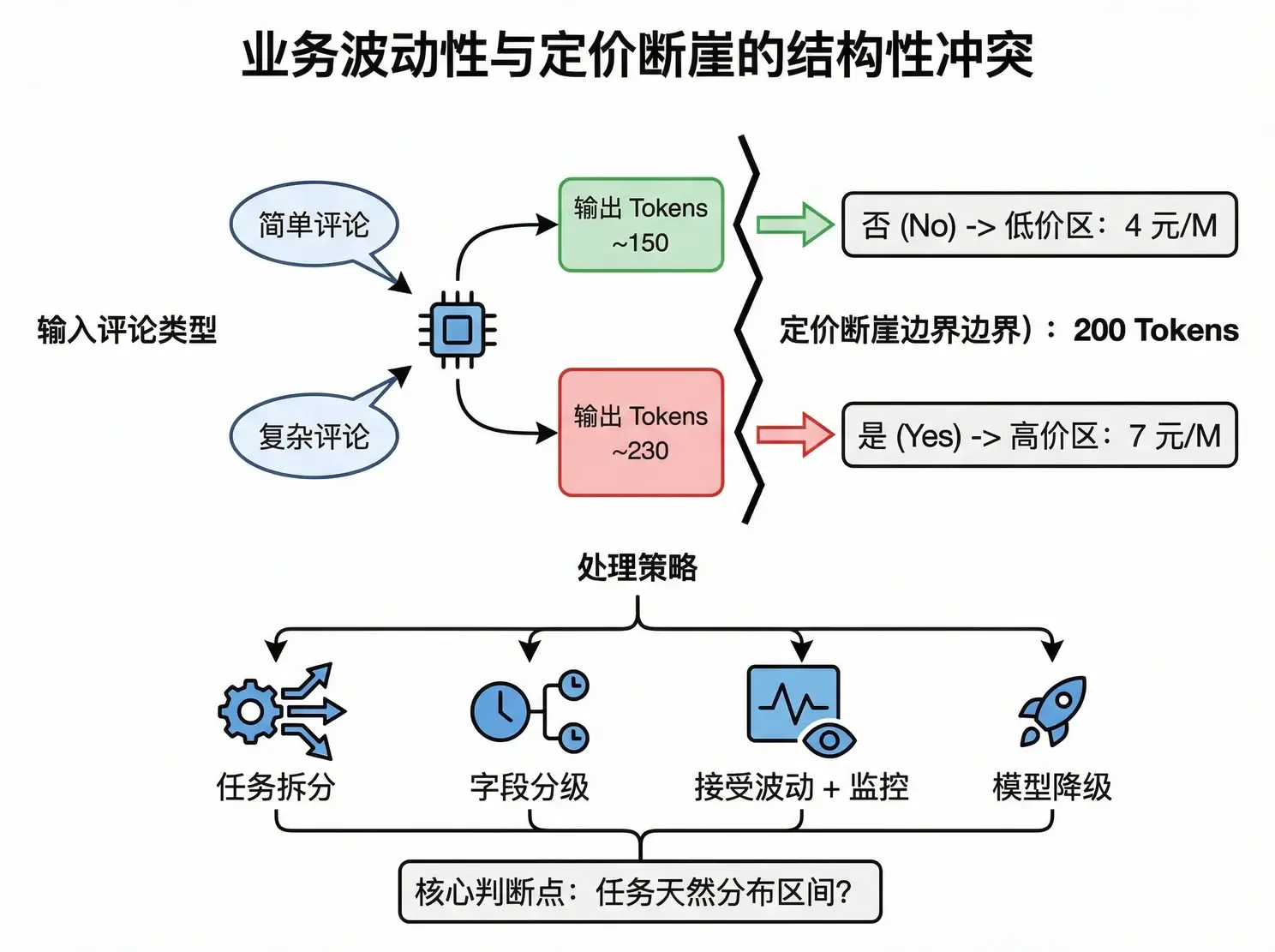
| Strategy | What you do | Trade-off |
|---|---|---|
| Task splitting | Split extraction into multiple calls; pull only 1–2 fields each time | More calls, higher latency |
| Field tiering | Extract core fields in real time; fill secondary fields async or in post-processing | More architectural complexity |
| Accept volatility + monitor | Allow occasional tier jumps, but monitor the overall distribution | Cost is controllable, not optimal |
| Model routing | Route price-sensitive high-volume tasks to a fast, lower-cost model | May trade a bit of accuracy |
The key question: where does this task's output naturally land? If most requests sit at 100–150 and only rarely cross 200, you can live with it. If the median is already 180–220, the task sits on the cliff—you must redesign task granularity, or switch to a model that doesn't tier by output. The same pattern shows up in codegen: a 20-line function easily burns 100+ Tokens, and a slightly more complex edit tip crosses 200.
Output-length tiering creates a 200-Token cliff: in this illustrative rate card, output rises 75% and input is rebilled 50% higher.
Pricing mirrors compute cost: long-output KV Cache and Attention grow nonlinearly—vendors use price to push you toward short, sharp work.
Check the output distribution first, then pick a strategy. Tasks whose median sits on the cliff need a granularity cut—or a different billing model.
Source: Adapted from the author's internal team share “AI Token Cost Engineering Strategies,” section “Short-Output Tiering.” The figures are an illustrative teaching rate card, not a live quote; check each provider's official pricing page for current thresholds and billing rules.
The complete interaction cost of “The pattern: output jumps, and input jumps with it”
“The easy-to-miss part: once output crosses 200 Tokens, the thousands of input Tokens you already sent also rebill at the higher price .” is a reminder that AI cost is not one price multiplied by one call. Input, output, retries, tools, waiting time, and human cleanup together decide what a task really costs.
Find what the bill repeats
The key variables behind “This mirrors the marginal-cost curve of inference compute.” are usually repeated context, oversized output, retries after failure, and calls that do not produce useful progress. Removing wasted Tokens can reduce cost, latency, and concurrency pressure at the same time.
A cheaper call can make the whole workflow more expensive
Start with “Check the output distribution first, then pick a strategy.” and keep a small table for input, output, retries, tools, and human review. Compare quality before and after optimizing instead of looking at one price in isolation.
From “The pattern: output jumps, and input jumps with it” to “Why a provider might price it this way”
“The pattern: output jumps, and input jumps with it” grounds the problem in “The easy-to-miss part: once output crosses 200 Tokens, the thousands of input Tokens you already sent also rebill at the higher price . Two extra words of output, and the whole request gets a retroactive price…”. “Why a provider might price it this way” then moves it toward “This mirrors the marginal-cost curve of inference compute. Short output (<200 Tokens) is light: Decode pressure is low, KV Cache footprint is limited, and it may finish in tens of milliseconds. Once output gets…”. Together, they show that the lesson is not just a conclusion to remember, but a claim with conditions.
Carry the judgment into the next situation
When analyzing cost, map the complete interaction first, then find repeated input, wasted output, and retries. A cheap individual call does not make the whole task cheap.
- “The pattern: output jumps, and input jumps with it”: The easy-to-miss part: once output crosses 200 Tokens, the thousands of input Tokens you already sent also rebill at the higher price . Two extra words of output, and the whole request gets a retroactive price…
- “Why a provider might price it this way”: This mirrors the marginal-cost curve of inference compute. Short output (<200 Tokens) is light: Decode pressure is low, KV Cache footprint is limited, and it may finish in tens of milliseconds. Once output gets…
- “The closing point”: Check the output distribution first, then pick a strategy. Tasks whose median sits on the cliff need a granularity cut—or a different billing model
The final “The closing point” brings the discussion to “Check the output distribution first, then pick a strategy. Tasks whose median sits on the cliff need a granularity cut—or a different billing model”. The useful thing to carry forward is knowing which judgments must be revisited when input, scale, or risk changes.
I turned one judgment from this article into a small experiment I could run today. Knowing what to observe next is more useful than simply remembering the conclusion.
After reading this, I first looked for the conditions behind the idea instead of copying the method into a project. That order made the later trade-offs much clearer.
When this judgment reaches real work, which constraint should be added first? I am curious which step matters most between reading and the first practical attempt.
No discussion on this article yet.